 Mika Wada
People say all kinds of things about azuki and international audiences — that Europeans won’t accept sweet beans, that they won’t accept black-colored food. But none of that turned out to be true.
Something delicious will be accepted as delicious. That’s the confidence I brought back from Lyon, France.
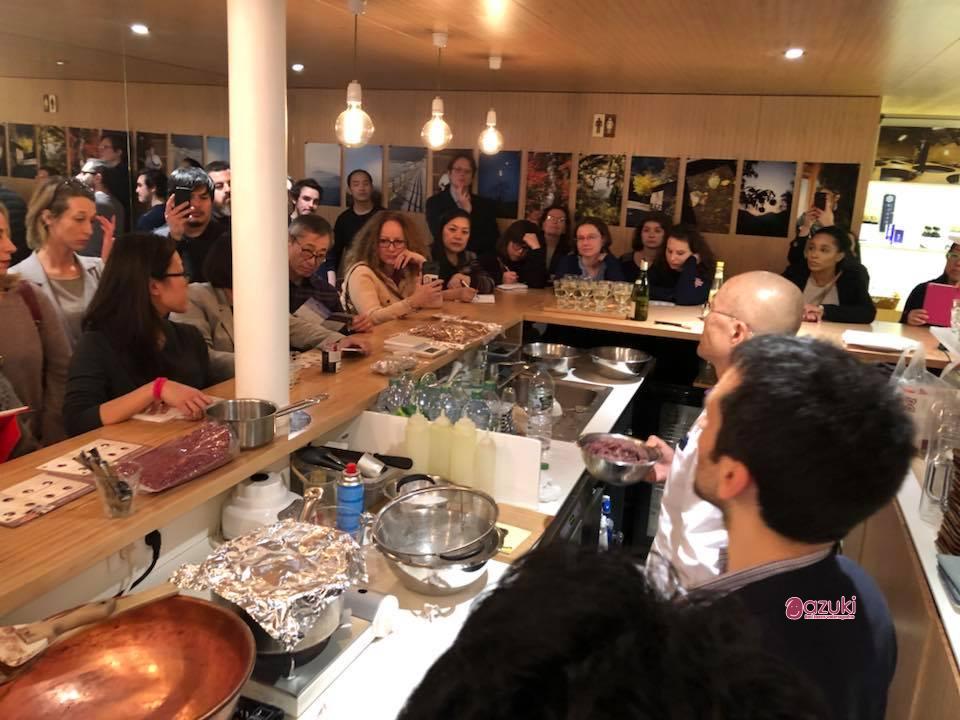
Morita Farm, an azuki bean farm in Shimizu, Tokachi, Hokkaido, exhibited at Sirha, a major food trade show held in Lyon, to introduce their azuki beans. Using Morita Farm’s azuki, wagashi craftsman Iwasaki, from Minamoto, a wagashi shop in Ota Ward, Tokyo, baked and served dorayaki right there at the booth.
I covered the azuki booth as a journalist, and got to witness firsthand what it’s like on the front lines of introducing azuki to European food professionals.
About Sirha 2019
Over five days, from Saturday, January 26 to Wednesday, January 30, 2019, Sirha — the International Catering and Hospitality Trade Show — was held in the food-loving city of Lyon, France. Held once every two years, this B2B trade show draws more than 200,000 foodservice-industry professionals from 133 countries worldwide.
Sirha is highly regarded as an event that shapes and broadcasts trends in the foodservice industry, drawing more than 25,000 renowned chefs from around the globe in search of new ingredients, and hosting some of the world’s most prestigious competitions, including the Bocuse d’Or — making it a focal point for media attention as well.
Around 30 Japanese companies and organizations exhibited at the JETRO-organized Japan Pavilion, showcasing items like mirin, soy sauce, sake, green tea, and azuki, alongside regional booths from places like Ehime and Kyoto — and the area drew plenty of foot traffic.
Two Kinds of Reactions to Azuki
A-net Farm Tokachi Co., Ltd. (Morita Farm) exhibited their delicious Tokachi, Hokkaido azuki — prized in Japan as a premium ingredient — with the goal of making it available for sale within the EU.
At the booth, azuki beans were laid out so visitors could pick them up and examine them directly, and the team gave live demonstrations of simmering the beans into anko paste and making dorayaki.
People who saw the azuki and stopped to ask questions tended to fall into two broad reactions.
One group asked, essentially, “Qu’est-ce que c’est?” (“What is this?”) with zero prior knowledge.
When we explained, “It’s a bean called azuki. To show how it’s used, we’re demonstrating turning it into a paste called anko, and serving it in dorayaki,” people would often follow up with, “Is it sweet? Salty? Spicy?” Once we said it was sweet, we’d often need to explain further what kind of sweetness it was.
Then they’d ask, “Do you eat it for breakfast? For dinner? When do you eat it?” — which meant explaining that in Japan, it’s eaten as a sweet, along with the kinds of occasions where it’s enjoyed.
Some people, apparently going by the color, would ask, “Is this chocolate?”
The other reaction was people who’d say, “Ah, haricots rouges” (“red beans”). This response suggested some vague sense that it was a type of bean, but without real understanding. In French, “haricots rouges” typically refers to kidney beans — the kind used in chili con carne, similar to Japanese kintoki beans.
Since they’d never seen azuki before, even though the size is quite different, calling it “haricots rouges” showed they were doing their best to make sense of something unfamiliar by relating it to something they already knew. Whenever someone said “Haricots rouges!” we’d gently correct them: “Not quite — we call this azuki,” and kept repeating “azuki” so they’d remember the name.
French People Trying Dorayaki for the First Time
Drawn in by the smell of the dorayaki wrappers being cooked, people kept stopping at the demonstration, and the crowd regularly spilled out past the edges of the booth.
Throughout the event, Iwasaki-san baked around 200 dorayaki every single day. People would stand and wait patiently in front of the booth the whole time the wrappers were cooking.
What struck me as truly impressive about French people was how, even those who had no idea what dorayaki was, would ask “What’s this?” and then eagerly go ahead and try it anyway.
One especially memorable gesture, among people trying dorayaki for the first time, was this: once the wrapper was cooked, the anko added, and the fresh dorayaki handed over, they would almost always bring it close to their nose and sniff it — carefully, sometimes twice, just to be sure — before finally taking a bite from the edge.
It seems that when trying something unfamiliar, people confirm it through smell first.
Then, almost without fail, they’d break into a huge smile on the first bite and give us a knowing “mmhmm” with their eyes. Reassured, they’d polish off the rest in a second bite, even licking the bit of anko left on their fingers as if reluctant to waste it.
The whole demonstration felt like a scene of pure, multisensory joy around azuki — the kind you rarely get to witness even in Japan. Some people told Iwasaki-san directly, “Excellent,” or “I’ve never had anything like this before.” One person, who’d started out asking “What is this?” and then stopped to try it, was so taken with the flavor that he excitedly suggested starting a dorayaki business locally.
As for how people described the flavor of azuki, when I listened to groups discussing their impressions of the dorayaki among themselves, many of them said it reminded them of chestnuts.
There were also a fair number of people who knew about dorayaki from having seen the film Sweet Bean (An), but had never actually tasted it until that moment. I was surprised that so many more people mentioned the film An than the Doraemon anime — it was my first real taste, outside Japan, of just how much influence a well-made film can have.
A Delicious Smile Is Universal
Take good azuki, cook it well, and turn it into delicious dorayaki. That alone was enough to make people smile with genuine delight — and that, for me, was a real revelation.
I think I’d been overthinking things — worrying that people wouldn’t try something unfamiliar, that only vegans would show interest, or that sugar and beans just wouldn’t work together. But throughout the event, crowds kept forming in front of the booth, and people drew in more people. Some told us, “I want to try it, so I’ll circle back again,” or “I heard through word of mouth that it’s delicious, so I came specifically to try it.”
It turns out that being delicious is simply enough — whether people know the food already or not doesn’t really matter. Even people who approached nervously, clearly unsure about trying something new, would light up with a huge smile the moment they tasted it and found it delicious. And that transformation happened regardless of skin color, gender, or age.
How to Spread Azuki to the World
What dorayaki, through Sirha, taught me is simply this: all we need to do is offer the flavor we genuinely believe in. There’s no need for tricks — turning it into chocolate, substituting the sugar with something else, or any other workaround. Serving delicious wagashi, made with delicious azuki, in the most straightforward way possible, is enough.
Even when the other person has never encountered it before, something delicious can be offered confidently, exactly as it is.
But that also means the flip side matters just as much: it has to genuinely taste good when eaten. Even a delicious product can lose its flavor once it’s engineered to withstand shipping, to last longer on shelves, or to cut costs. I came away feeling that focusing on passing down the craft of making truly good anko — and communicating that flavor directly — may be the real shortcut to spreading azuki around the world.
What We Shouldn’t Forget, Even Here in Japan
This experience brought me back to a realization: we ourselves, in Japan, may not always be eating anko and wagashi — foods often called part of the Japanese soul — while truly savoring how delicious they are.
These days, we’re more likely to eat wagashi from a convenience store or supermarket, or long-shelf-life wagashi received as gifts, than wagashi bought fresh from a proper wagashi shop.
Simply being able to recognize something delicious as delicious is enough to bring a smile to your own face. I want to hold onto the ability to judge and choose good anko and good wagashi for myself — based on flavor, not on brand name or price.
With thanks to:
A-net Farm Tokachi Co., Ltd. (Morita Farm) — https://www.azukilife.com/
Minamoto Wagashi — https://www.facebook.com/dorayakis.minamoto/
Morita Farm Azuki — Product Notes
For those looking for large, premium-grade azuki (Dainagon-class):
- Premium Azuki (Hokkaido-grown), 600g — ¥1,100. Specially selected for extra-large grain size from heirloom varieties grown under Tokachi’s open skies. A glossy, flavorful whole-bean anko awaits. Grains are selected at 5.5mm or larger, the same standard as Dainagon-grade beans. Packaged in a foil pouch that blocks direct sunlight.
- Premium Azuki (Hokkaido-grown), 5kg — ¥6,500. Same description as above, in bulk size.
For those who want to casually cook up a delicious anko:
- Harebare Azuki (Hokkaido-grown), 600g — ¥810. Made from the “Kitaroman” variety, grown under Tokachi’s open skies. Prized for its tender skin. Great for casual use in dishes like inaka-jiruko (rustic sweet red bean soup) or azuki rice. Grains are slightly smaller.
- Harebare Azuki (Hokkaido-grown), 5kg — ¥4,900. Same description as above, in bulk size.
ABOUT THE AUTHOR
Mika Wada, Editor-in-Chief, Azuki Editorial Team
During a period when swelling and fatigue made both her work and parenting difficult, she found her way back to good health by eating azuki brown rice meals and her own original azuki cereal every day. Having previously worked in the beauty industry, she had already come to appreciate how essential daily diet is to beauty that shines from within — which led her to start Azuki.tokyo as an ambassador spreading the goodness of azuki to women around the world.